Following up on the E-Stim Exoskeleton post from Feb. 16, about electrical stimulation (e-stim). What is it and how does it work?
In rehabilitation, Electric Muscle Stimulation (EMS) is a way to urge muscle response. Patches with wires are put directly on targeted muscles. Electrical impulses are then sent from a machine in order to make those muscles contract. E-stim can be a way to effectively build or maintain muscle tone. There is another type of electrical stimulation called Transcutaneous Electrical Nerve Stimulation (TENS), primarily used for treating chronic pain. Functional Electrical Stimulation (FES) is the therapeutic application of e-stim. Some people use FES bicycles at home after a SCI.
The ability to use e-stim depends on precisely how and where an injury to the nervous system occurs. Damage to lower motor neurons (LMN, as opposed to upper motor neurons) compromises muscle innervation, meaning that e-stim isn't necessarily an option for muscle rebuilding or maintenance. With LMN trauma, again depending on the cause and type, voluntary muscle movement and reflexes are lost. E-stim may not cause any muscle contraction if LMN damage is a factor. (This has been the case for me so far. One therapist said it was a 50/50 chance that e-stim would work after a SCI. But keep reading.)
I've read in passing that e-stim must be begun very early on after the injury, and that if it is not utilized at all within the first two weeks or so, then those particular peripheral nerves quit firing in response. Whether that's true I can't say. In my limited experience, when they say it can't be done, it's still worth the try! Studies on the use of FES for spinal cord injury rehabilitation are ongoing.
Saturday, February 25, 2017

Sunday, February 19, 2017
TetraStem Press Release
A new topical treatment is making the news (albeit low-key) for its potential in spinal cord injury recovery. TetraStem is created by Phillips Company and reportedly converts your own cells into stem cells. According to the press release, which details the ongoing recovery of a young woman named Miranda, Phillips Co. is interested in finding others who would like to be involved in the trials process for TetraStem.
Research like this tends to take a backseat to traditional pharmaceuticals, in part because your personal stem cells belong to you and cannot be patented.
Something to think about!
Research like this tends to take a backseat to traditional pharmaceuticals, in part because your personal stem cells belong to you and cannot be patented.
Something to think about!
Thursday, February 16, 2017
E-Stim Exoskeleton
Clinical trials at UCLA are putting together an exoskeleton and electrical stimulation (e-stim). E-stim encourages the body to take part in helping the robotic exoskeleton, and allows for the potential to recover - meaning this sort of device may be more functional than traditional exoskeletons, because it will be useful for therapy, as well.
Tuesday, February 7, 2017
Recovery Video: Going Forward
A personal update: walking forward with only ankle sport-braces in this video. I'm still working to drop long leg orthotics. This has been the official bracing sequence: from bilateral locked KAFOs (Knee-Ankle-Foot Orthotics locked at the knee, as Franklin D. Roosevelt used) to unlocked KAFOs to modular KAFOs/ AFOs (Ankle-Foot Orthotics without locks and with very mild knee support). In a past video, I showed walking backwards with the same combination of ankle support wraps. Because walking in different directions requires different muscle groups, intervals of both have been an important part of recovery since the very beginning (see previous videos on my YouTube channel). It's much harder than it looks!
Tuesday, January 31, 2017
A Recovery Story
Here's an encouraging article about a woman who is making rapid and sudden gains in her recovery - 17 years later! Work with what you have whenever you can.
Thursday, January 26, 2017
The Benefits of Standing
Near and dear to my mind are the benefits of standing. Research indicates that standing is healthy for everybody, leading to trends such as the standing desk. Many sites such as EasyStand and JustStand.org provide informative research and links. Being upright is especially important after long times of sitting or lying down, when blood pressure variations can be a serious and even lethal problem. This is why rehabilitation after a spinal cord injury (SCI) begins with learning to sit up again, then moving to tilting tables or standing frames as possible.
 With SCIs, standing is about more than exercise. It involves helping with blood pressure changes, developing core strength, promoting bone density, decreasing nerve pain, enhancing psychological health, and more. (How much would you miss eye contact at eye level?)
So why this is near and dear to me? Released from rehabilitation, I had been told to expect nothing significant beyond some slight hip movement. Personally, my progress looked like it was grinding to a now-or-never halt when therapy stopped. Nerve and back pain, living logistics, and muscle memory were all big factors in looking for ways to be on my feet. Trial-and-error included everything that seemed remotely feasible: pulling up against a stool, standing supported against the edge of a couch, etc.
 Well, everything but the kitchen sink - that came on Jan. 1, 2014, when I began propping up against the counter with pillows and holding on. The first time lasted for four minutes, with increasing amounts in daily intervals, growing to fourteen hours by that spring. Hardly an easy or perfect solution (not for osteoporosis anyway; more on that another time), and probably not recommended - but it helped me, and I was regaining muscle control and taking supported steps by the end of it. And by the summer, my knees were occasionally holding me up unsupported.
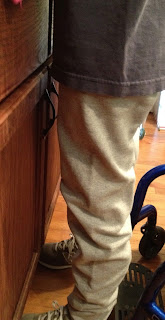 Recurring disclaimer: This site is never intended to give medical advice or claim that the kitchen sink is a standing frame to replace other techniques. Standing with braces has also been a great part of my recovery (see video links below). These posts are about sharing my story and encouraging others to think outside of the box for ways to pursue mobility and health. Brainstorming, like standing, has its benefits!
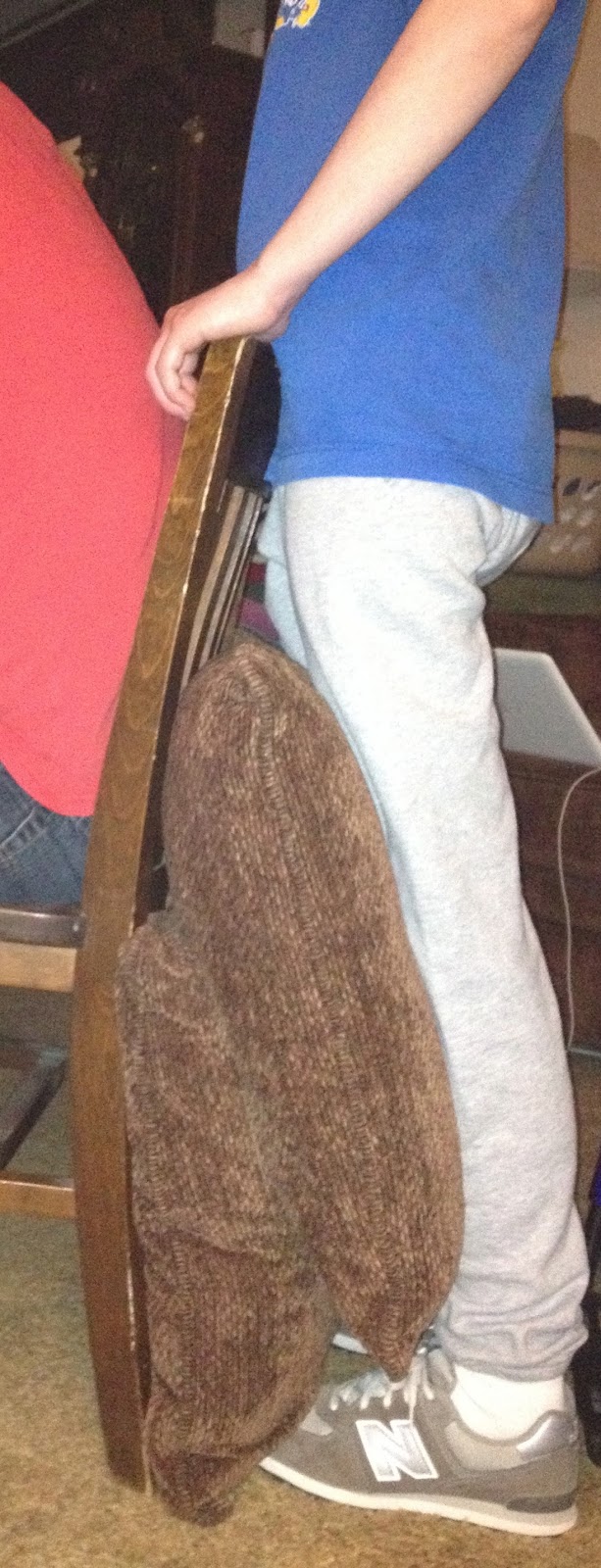 With SCIs, standing is about more than exercise. It involves helping with blood pressure changes, developing core strength, promoting bone density, decreasing nerve pain, enhancing psychological health, and more. (How much would you miss eye contact at eye level?)
So why this is near and dear to me? Released from rehabilitation, I had been told to expect nothing significant beyond some slight hip movement. Personally, my progress looked like it was grinding to a now-or-never halt when therapy stopped. Nerve and back pain, living logistics, and muscle memory were all big factors in looking for ways to be on my feet. Trial-and-error included everything that seemed remotely feasible: pulling up against a stool, standing supported against the edge of a couch, etc.
 Well, everything but the kitchen sink - that came on Jan. 1, 2014, when I began propping up against the counter with pillows and holding on. The first time lasted for four minutes, with increasing amounts in daily intervals, growing to fourteen hours by that spring. Hardly an easy or perfect solution (not for osteoporosis anyway; more on that another time), and probably not recommended - but it helped me, and I was regaining muscle control and taking supported steps by the end of it. And by the summer, my knees were occasionally holding me up unsupported.
Saturday, January 21, 2017
Poikilothermia, Weather or Not
Playing Scrabble to pass a cold January evening?
Here’s a word to pick up at least 25 points: poikilothermia (that’s 3+1+1+5+1+1+1+1+4+1+1+3+1+1).
The first half comes from the Greek word ποικίλος (-η, -ον; poikilos). Among other things, it means “various,” “changeable,” or “manifold.” Related to the Greek θερμός (-ή, -όν; thermos), the second half means “hot” or “warm.” Put the two parts together and you have a reference to variable body temperature, a medical issue often to be associated with spinal cord injury.

People have different ways of fighting poikilothermia. A quick search brings up a lot of ideas, but here are some tips.
For another Scrabble tip, convert the word to poikilothermic.
Subscribe to:
Posts (Atom)